

How Much Warehouse or Flex Space Do You Actually Need?
Calculating how much industrial space your business needs is both more straightforward and more technical than office space planning. More straightforward because the inputs are largely operational — how much product, how many trucks, what kind of equipment. More technical because the wrong specs can make a space completely unusable for your operation no matter how good the price is.
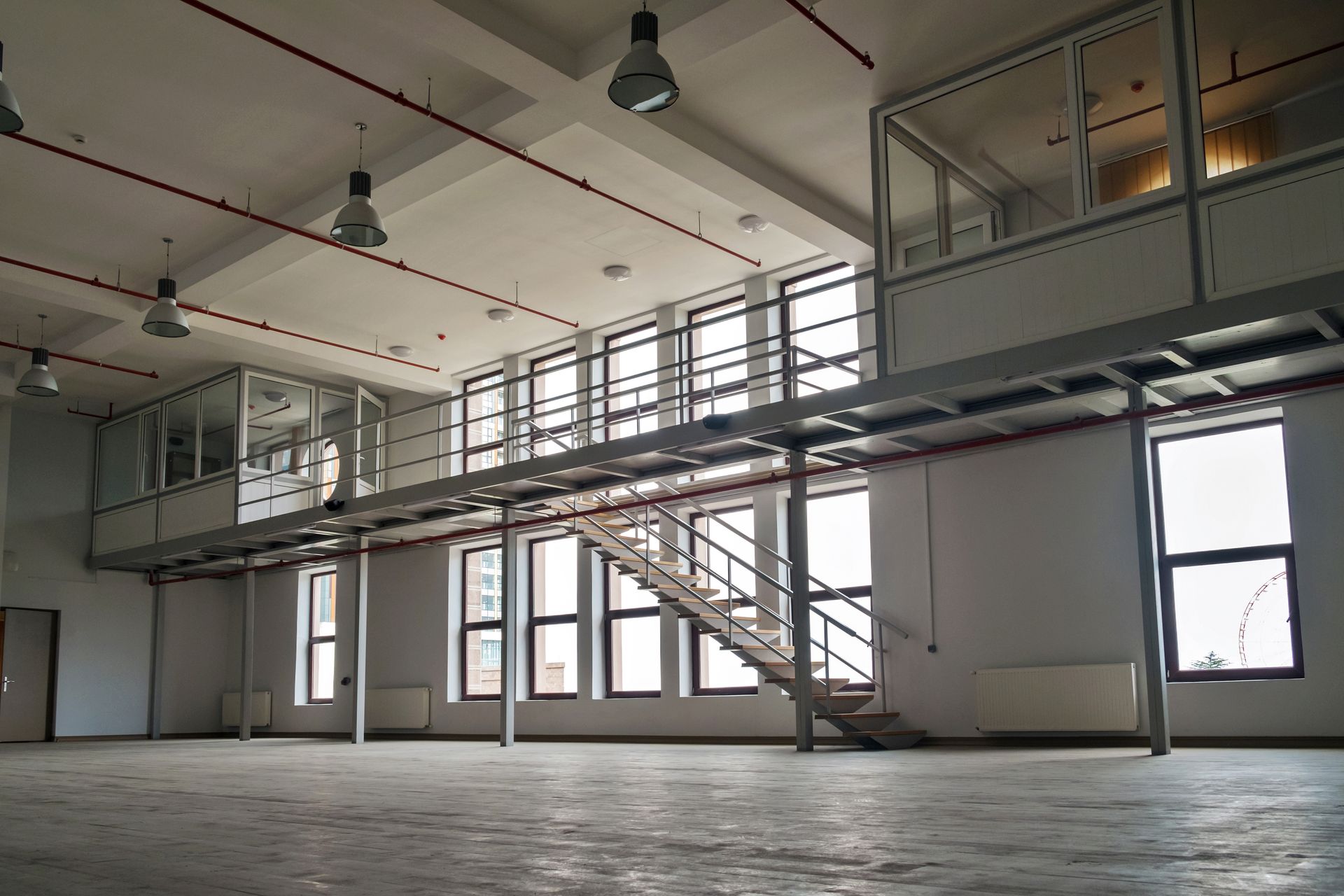
Start With Your Operation, Not a Square Footage Number
The most common mistake industrial tenants make is starting with a square footage number — usually inherited from the space they're currently in — and looking for something similar. The right approach starts with your operation and works backward to a space requirement.
Ask yourself: what does my business actually do in this space? Distribution, light manufacturing, service and repair, flex office with storage, food processing, e-commerce fulfillment? Each use has fundamentally different space needs, and each should generate a different set of requirements before you ever pull up a listing.
Inventory and Storage: Building Your Footprint
For distribution, warehousing, and fulfillment operations, your storage requirement is the starting point.
Begin with your peak inventory levels — not average, but peak. You need to accommodate your busiest period, not your typical week. Factor in seasonal fluctuation, supplier lead times, and any safety stock requirements.
Next, determine how you're storing that inventory. Floor-stacked pallets, single-deep racking, double-deep racking, drive-in rack, push-back systems, or high-density mobile systems each have radically different footprint and clear height requirements. A business that floor-stacks pallets four high needs less clear height than one running 40-foot racking systems with reach trucks.
Work with your operations team to calculate your pallet positions or your SKU count and required pick faces. From there, a warehouse designer or an experienced broker can help you translate that into a required square footage and, critically, a required clear height.
Clear Height: The Spec That Limits Everything Else
Clear height — the usable vertical space from floor to the lowest obstruction — is the single most important physical specification in industrial real estate, and it's fixed. You cannot add clear height to a building. If a facility has 24-foot clear and your operation requires 28-foot, the building simply doesn't work for you. Period.
Before you look at a single building, know your clear height requirement. Factor in your racking height, plus at least 18 to 24 inches of clearance above the top beam for sprinkler system deflection requirements, plus the height of your tallest lift equipment at full extension.
In today's market, most newer industrial facilities run 28 to 36 feet clear. Older or multi-story industrial buildings can be as low as 14 to 18 feet, which limits them to floor-level storage or light manufacturing applications. Know what you need before you tour.
Dock Doors and Grade-Level Access
How product enters and exits your building drives your dock and door requirements. There's no universal formula — it depends entirely on your receiving and shipping volumes, your carrier mix, and your operational hours.
For a basic starting point: one dock door per 10,000 to 15,000 square feet of warehouse space is a common planning ratio for moderate-throughput distribution. High-velocity fulfillment or cross-dock operations may require significantly more.
Grade-level doors — roll-up doors at floor height — serve forklifts, smaller trucks, and drive-in loading. They're essential for manufacturing and service operations and common in flex space. Know how many and what size you need.
Also factor in your truck court. If you're running 53-foot trailers, you need a truck court depth of at least 130 feet on the dock side. A building that looks right on the inside but sits on a tight site may create serious operational constraints.
Electrical Power: Know Your Requirements Before You Search
Electrical infrastructure is one of the most expensive and time-consuming aspects of industrial space to upgrade, and many landlords are not willing or able to bring significant additional power to a building. You need to know your power requirements before you search — not after you fall in love with a space.
Work with your facilities or operations team to identify:
- Your total connected load in amps and voltage
- Whether you need three-phase power (most manufacturing and heavy equipment does)
- Any specialized requirements: EV charging infrastructure, cold storage refrigeration, compressed air systems, specialized manufacturing equipment
Then verify available power at every building you seriously consider. Ask for the utility service entrance specs and, if you have any doubt, have an electrician review the existing infrastructure before you proceed to lease negotiation.
Office Component: How Much Do You Actually Need?
Most industrial buildings include some office space — anywhere from 5% to 25% of the total square footage. The right ratio depends on your headcount, your administrative functions, and whether you have client-facing activity.
Don't pay for office space you won't use. A 100,000 SF warehouse with a 15,000 SF office component when you need 5,000 SF means you're heating, cooling, and paying rent on 10,000 SF of office you'll never occupy productively. Conversely, don't underestimate your office needs — adequate space for your team, your HR and accounting functions, and any compliance or safety administration matters.
Yard and Outdoor Storage
Does your operation require outdoor storage — trailers, containers, raw materials, heavy equipment, vehicles? Many industrial properties restrict or prohibit outdoor storage based on municipal zoning or deed restrictions. If you need a yard, verify that it's available and permitted before you go any further in the process.
Secured yard space is a premium — not all industrial sites have it, and those that do often limit the acreage. Know your requirement early.
Plan for Growth Without Overcommitting
Industrial leases typically run three to ten years or more. A lot can change in that time. Rather than signing for 50% more space than you need today, consider negotiating:
- Expansion options on adjacent space in the same building or park
- Early termination rights if you need to scale down
- A build-to-suit agreement if your long-term requirement is large and stable enough to justify a custom facility
These tools give you flexibility without the carrying cost of unused space from day one.
The Right Approach: Operations First, Buildings Second
The most expensive industrial real estate mistakes happen when tenants fall in love with a building before verifying that it actually works for their operation. A great location at a great price means nothing if the clear height is wrong, the power is insufficient, or the site can't accommodate your trucks.
Define your operational requirements first. Build your spec sheet: clear height, power, dock count, grade-level doors, truck court, office ratio, yard needs, and square footage based on your storage and workflow analysis. Then go to market looking for buildings that meet that spec.
You'll tour fewer properties. You'll waste less time. And you'll end up in a space that actually serves your business.
Ready to build your industrial requirements spec?
That's where every successful search starts — let's work through it together.